Concord MC | Professional Insight
Prescription Pruning: Protecting Your Public Capital Investment in Street Trees
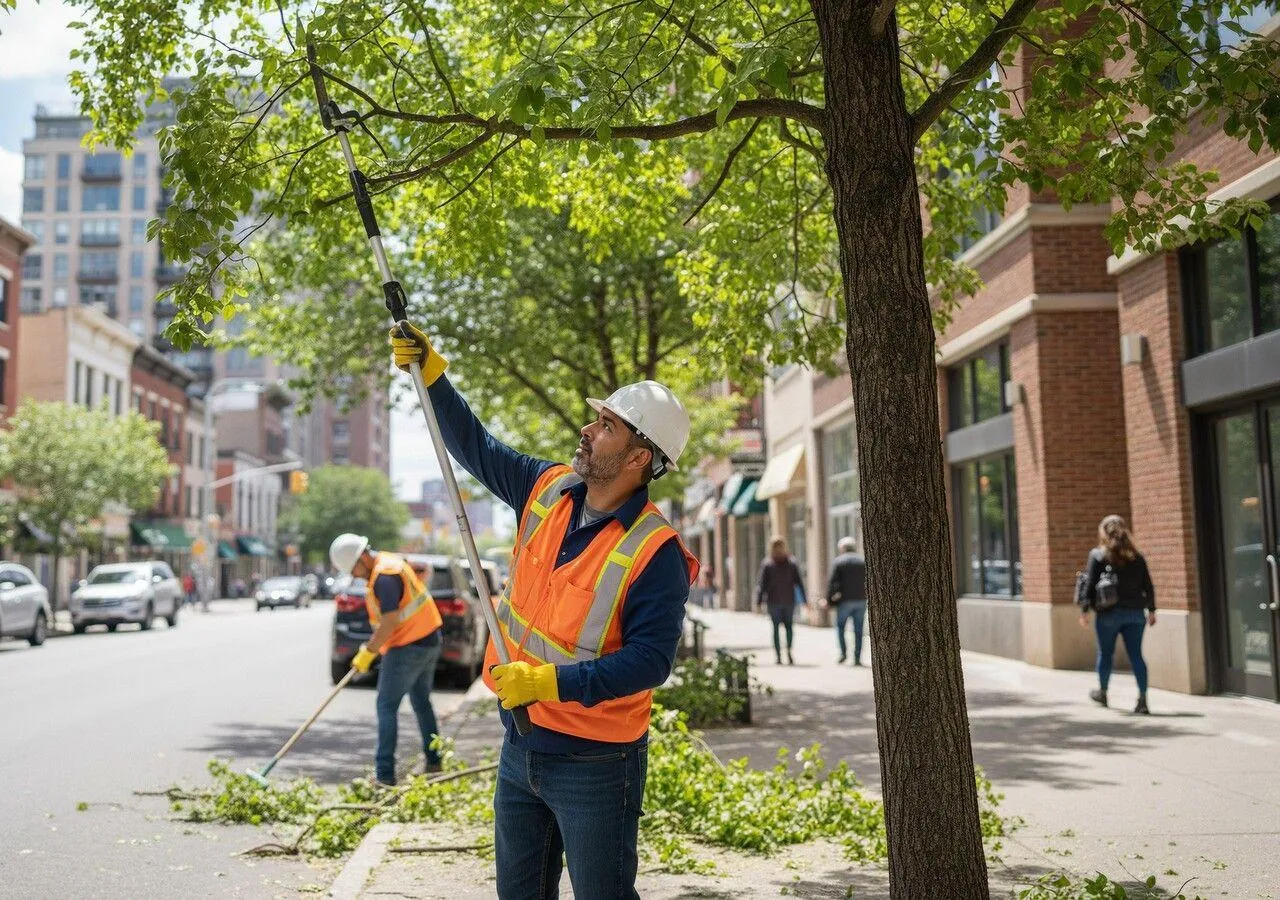
Why Municipalities Should Begin Structural Pruning 3 to 5 Years After a New Street Tree is Planted
Almost all municipalities invest public funds in street trees through capital projects, redevelopment approvals, environmental grants, replacement programs, and volunteer planting initiatives. The public sees the immediate result: a newly planted tree adding life to a residential street or business district. What is less visible is the maintenance obligation that begins after the planting contractor leaves.
A new street tree is not a “plant it and forget it” asset. It is young municipal infrastructure whose future structure is still forming. Without follow-up pruning, small defects become large problems. Competing leaders increase in diameter. Low temporary branches extend over sidewalks and travel lanes. Closely spaced limbs become crowded, and narrow unions may develop included bark. By the time these conditions interfere with trucks, signs, lighting, buildings, or pedestrians, correction may require large cuts, specialized equipment, traffic control, and greater expense.
Municipalities can interrupt that pattern through prescription pruning: an objective-based process that specifies why a tree is being pruned, what conditions are being addressed, where cuts will be made, what types of cuts will be used, and how much material will be removed. For newly planted street trees, the first planned structural-pruning intervention should generally occur after establishment, commonly during the third through fifth year.
From “Trim the Trees” to a Written Prescription
The Prescription Pruning Qualification: Prescribing Arborist Manual and Workbook, developed by Edward F. Gilman and the Florida Chapter of the International Society of Arboriculture, advances a clear principle: no tree, or group of trees, should be pruned without a prescription.
That concept is especially useful in municipal government. A direction such as “prune the trees on Main Street” leaves too many decisions undefined. One crew may remove low branches. Another may thin the crown. A contractor may interpret the assignment as clearance pruning while the shade tree commission expects structural development.
A sound prescription connects the owner’s and arborist’s conditions of concern; the pruning objective; the part of the crown where work will occur; the type of cut; the amount or dose of pruning; and the interval before the next inspection. The PPQ manual further describes five practical elements:
- The number or range of cuts
- The diameter or diameter range of the cuts
- The type of pruning cut
- The location of the cuts
- The plant part to be removed
This detail creates accountability. It allows the prescribing arborist to communicate clearly with pruning crew or production arborist, gives a contractor a measurable scope, and provides an inspection standard when the work is complete.
Prescription pruning is therefore more than a technical arboricultural exercise. It is also a municipal management and procurement tool. It converts a broad maintenance request into an objective, inspectable work assignment.
Why Three to Five Years Is the Critical Window
The International Society of Arboriculture recommends limiting pruning at planting mainly to dead or broken branches and withholding most other pruning until the second or third year, after the tree has recovered from transplanting. ISA also emphasizes that trees pruned appropriately while young generally require less corrective pruning as they mature.
The PPQ manual’s 25-year training plan begins at planting and returns to the tree approximately two or three years later, at five years, and then at longer intervals. Street-tree structure is therefore developed through a series of modest, purposeful interventions rather than one aggressive pruning event.
The three-to-five-year period matters because defects are visible, but most corrective cuts are still small. Many trees can be treated from the ground with hand pruners, loppers, or pole tools. A competing stem can often be subordinated with reduction cuts instead of being removed with a large wound. A low branch can be shortened and retained temporarily rather than allowed to become a major limb that must later be removed from the trunk.
Early pruning improves both tree biology and municipal economics. The work is simpler, equipment needs are lower, cuts are smaller, and future growth can be guided before clearance conflicts develop. UF/IFAS identifies structural pruning to guide tree architecture, so trees resist failure, provide clearance, retain an appropriate crown, and remain useful longer.
What the First Prescription Should Accomplish
The first prescription should not attempt to create a finished mature crown. It should establish a path for development.
For species and growth forms that naturally support a central leader, the prescriber should identify the leader to retain and reduce the growth of competing stems. Subordination is often preferable to immediate removal. A reduction cut shortens a competing stem back to an appropriately sized lateral branch, slows its extension growth, and directs more growth into the retained leader. Additional work can occur during a later pruning interval.
The PPQ training plan recommends reducing or removing stems and branches whose diameter exceeds approximately one-half the diameter of the trunk or parent stem at the union. This relationship is known as the branch aspect ratio. Large aspect ratios, codominant stems, included bark, and clustered branches deserve early attention because they become harder to correct as their diameter increases.
The prescription should also address branch spacing. At approximately five years, most first-order branches on a small-caliper street tree are still temporary. They contribute foliage, trunk taper, and protection to the developing trunk, but many will not remain in the mature crown. Rather than stripping the lower trunk, the municipality should keep temporary branches small through reduction and remove them gradually over several pruning cycles.
The prescriber should also identify:
- Aggressive lower branches growing upward into the top third of the crown
- Branches clustered at the same location on the trunk
- Rubbing or crossing branches
- Codominant leaders and weak unions
- Low limbs likely to create future clearance problems
- Branches competing with the selected permanent structure
The objective is to develop one dominant path of growth where appropriate, avoid concentrations of large branches, and begin reserving suitable positions for permanent support limbs.
Clearance Must Be Developed, Not Forced
Street trees eventually must accommodate sidewalks, parked vehicles, delivery trucks, buses, snow-removal equipment, signs, streetlights, and adjacent buildings. Immediate removal of every low branch, however, is not sound crown raising.
ISA notes that many branches present at planting will eventually be removed for pedestrian and vehicle clearance, but it also warns against removing too much canopy because leaves and supporting branches are important sites of energy production and storage.
A prescription should therefore distinguish between the future permanent crown and the current temporary crown. Low branches that will eventually be removed can be shortened so they remain subordinate, then removed later as the leader and upper crown develop.
This approach avoids the familiar appearance of a thin young trunk with a small tuft of foliage at the top. It also prevents temporary branches from becoming so large that their eventual removal creates major trunk wounds.
Clearance objectives must be site-specific. A tree beside a residential sidewalk does not have the same operating requirements as one along a truck route, in a downtown loading zone, beside a bus route, or within a municipal parking lot. The prescription should state the clearance to be developed and the interval for reaching it rather than directing crews to remove all low growth during one visit.
The long-term location of the lowest permanent limb should be considered early. The PPQ manual’s example program anticipates a permanent crown high enough to avoid future drooping limbs and repeated clearance conflicts. Actual municipal requirements should reflect the tree species, mature form, roadway classification, sidewalk conditions, local ordinances, and applicable transportation standards.
Pruning Dose Is a Management Decision
One of the most useful PPQ concepts is pruning dose: the amount of material removed during a pruning event. The prescriber should develop dose through observable measures such as the number, diameter, and type of cuts rather than relying only on a subjective percentage of crown removal.
For example, a prescription might call for a specified number of reduction cuts within a stated diameter range on the largest first-order branches competing with the leader. That direction is more measurable than simply telling a contractor to “lightly thin” or “remove approximately 20 percent of the crown.”
The appropriate pruning dose depends on:
- Species and growth habits
- Tree age and vitality
- Nursery stock quality
- Soil and site conditions
- Branch diameter and length
- Structural conditions of concern
- Available rooting volume
- The interval before the tree will be pruned again
The PPQ example program explains that at least approximately half of the live foliage remains on young trees during early interventions. That should be understood as an upper limit within a structured training plan, not a routine target. Many trees will require substantially less pruning.
A municipal prescription should favor the smallest dose that accomplishes the stated objective and uses repeated pruning intervals when substantial correction is needed. Pruning a branch slows growth on that branch in proportion to the dose and can direct future growth into portions of the crown that were not pruned.
The purpose is not to produce the largest brush pile. It is to influence future architecture with the least necessary injury.
The DPW and Shade Tree Commission Partnership
Prescription pruning works best when municipal responsibilities are clear.
The Department of Public Works is usually positioned to administer the operating program. DPW maintains planting records, schedules employees, manages equipment and work zones, coordinates contractors, and responds to service requests. It can identify annual groups of trees entering their third, fourth, and fifth growing seasons and combine structural inspections with stake removal, mulch correction, watering, and establishment checks.
The shade tree commission provides policy continuity and long-range stewardship. It can recommend specifications, support annual funding, review priorities, educate residents, and report program results to the governing body. It can also help ensure that grants, redevelopment agreements, and developer-funded planting projects include establishment care and an early-pruning visit rather than ending with installation.
The most effective division of responsibility is generally:
Shade tree commission: policy, planning, advocacy, public education, and program oversight.
Department of Public Works: scheduling, staffing, equipment, traffic control, contractor management, and field execution.
Municipal or consulting arborist: prescriptions, technical supervision, training, and quality-control inspection.
A PPQ trained municipal arborist, qualified consulting arborist, or municipal employee should prepare or approve prescriptions and inspect completed work. Production personnel should understand branch aspect ratio, reduction and removal cuts, branch-collar protection, temporary branch management, and species-appropriate form.
Municipal specifications should require conformance with the current ANSI A300 pruning standard and applicable ANSI Z133 safety requirements. ISA also makes clear that topping is not an acceptable substitute for reduction or structural pruning. Topping can contribute to decay, stress, poor form, repeated maintenance costs, and unacceptable risk.
A Practical Municipal Program
A municipality can begin prescription pruning without creating a new bureaucracy.
First, compile planting records from the previous five years and list trees by installation year, species, location, and planting project. Second, inspect the three-to-five-year cohort and group trees with similar size, condition, and pruning needs. Third, prepare a prescription for each tree or defensible group of comparable trees. Fourth, complete the work with trained employees or a qualified PPQ-trained contractor. Fifth, inspect and document the results and establish the next pruning interval.
The tree inventory or maintenance record should note:
- The condition of concern
- The pruning objective
- The work prescribed
- The work completed
- Any deferred correction
- Photographs when useful
- The next inspection or pruning year
Useful program measures include the percentage of eligible trees inspected, percentage pruned on schedule, average cost per tree, number of competing leaders subordinated, contractor rework, and the number of trees later requiring large corrective cuts.
These records allow municipal leaders to recognize prescription pruning for what it is: preventive maintenance of a public asset.
Completing the Planting Program
Municipalities routinely budget for the purchase and installation of trees but fail to reserve funding for the period when structure can be improved most efficiently. That is an incomplete capital program.
A successful street-tree program connects nursery-stock selection, proper planting, watering, mulch and stake management, inventory updates, prescription pruning, and future inspections. The tree is not finished when it is planted. It is placed on a developmental pathway that municipal government must manage.
The policy recommendation is simple: every municipal street-tree planting program should include a written structural-pruning prescription and a funded pruning visit during approximately years three through five, followed by documented pruning intervals based on species, condition, and site.
Planting creates the opportunity. Prescription pruning protects the investment and helps transform a young tree into safe, durable, functional municipal infrastructure.
References and Technical Sources
Gilman, Edward F. Prescription Pruning Qualification: Prescribing Arborist Manual and Workbook. Florida Chapter International Society of Arboriculture, 2024.
International Society of Arboriculture. Pruning Young Trees. TreesAreGood.org, 2021.
International Society of Arboriculture. “Pruning Trees.” TreesAreGood.org.
Gilman, Edward F. “Pruning Shade Trees in Landscapes.” University of Florida Institute of Food and Agricultural Sciences.
Gilman, Edward F., and Amanda Bisson. “Developing a Preventative Pruning Program.” University of Florida Institute of Food and Agricultural Sciences.